
FS25 Realistic Water & Soil Management (RWSM) v1.3.3.1
Realistic Water & Soil Management expands Farming Simulator 25 with a comprehensive simulation of weather, soil water, irrigation, soil compaction, plant roots, weed competition and yield development. The values are calculated locally for individual soil areas. This can create different conditions within a field: one area can be dry and stable, while another has poorer growing conditions due to waterlogging, compaction or repeated passes.
Weather and regional climate data
RWSM supplements the game weather with regional real climate and precipitation profiles from the last 10 years. It includes 39 countries, several regions per country as well as all 16 German federal states with regional subdivisions. Among other things, the amount of precipitation, monthly distribution, temperature, evaporation, dry phases and different seasons in the northern and southern hemisphere are taken into account.
Rain, thunderstorms, snow and hail or their water equivalent are recognized. Precipitation is stored and flows permanently into the soil water balance.
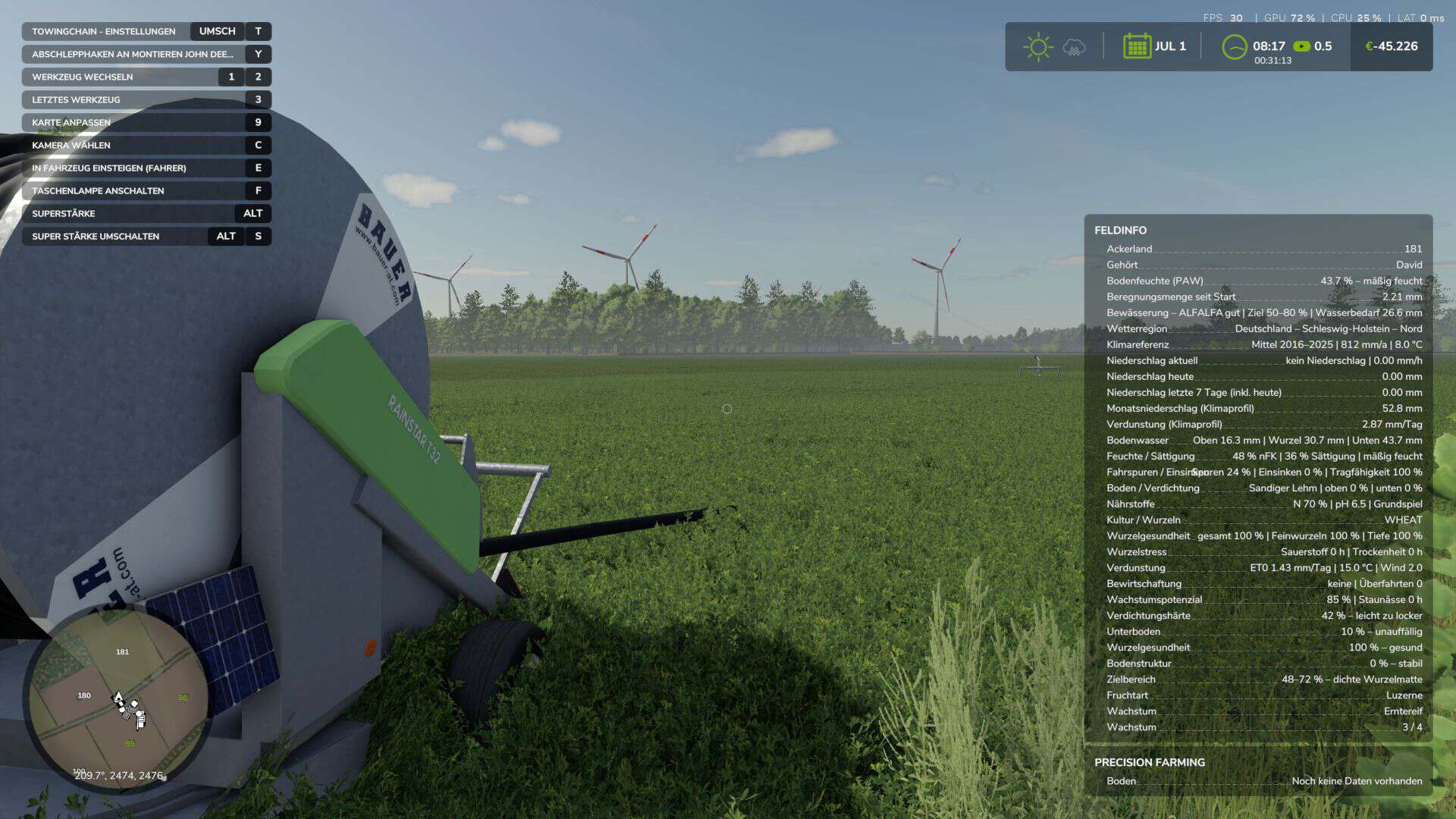
Multi-layer soil water balance
– The floor is calculated in three layers:
– Topsoil, about 0-10 cm
– Root zone, about 10-30 cm
– Underbody, about 30-60 cm
The amount of water, water available to plants, saturation, infiltration, drainage, evaporation, seepage and waterlogging are calculated for each layer. Plant available water and physical saturation are separate values. A soil moisture content of over 100 percent does not automatically mean that the soil is completely saturated.
Soil types
– The mod distinguishes:
– loamy sand
– sandy loam
– Clay
– silty clay
Each soil type has its own values for field capacity, wilting point, saturation, infiltration, drainage, compaction sensitivity, mud line and bearing capacity. Light soils dry out more quickly, while heavy soils store more water but are more prone to waterlogging and compaction.
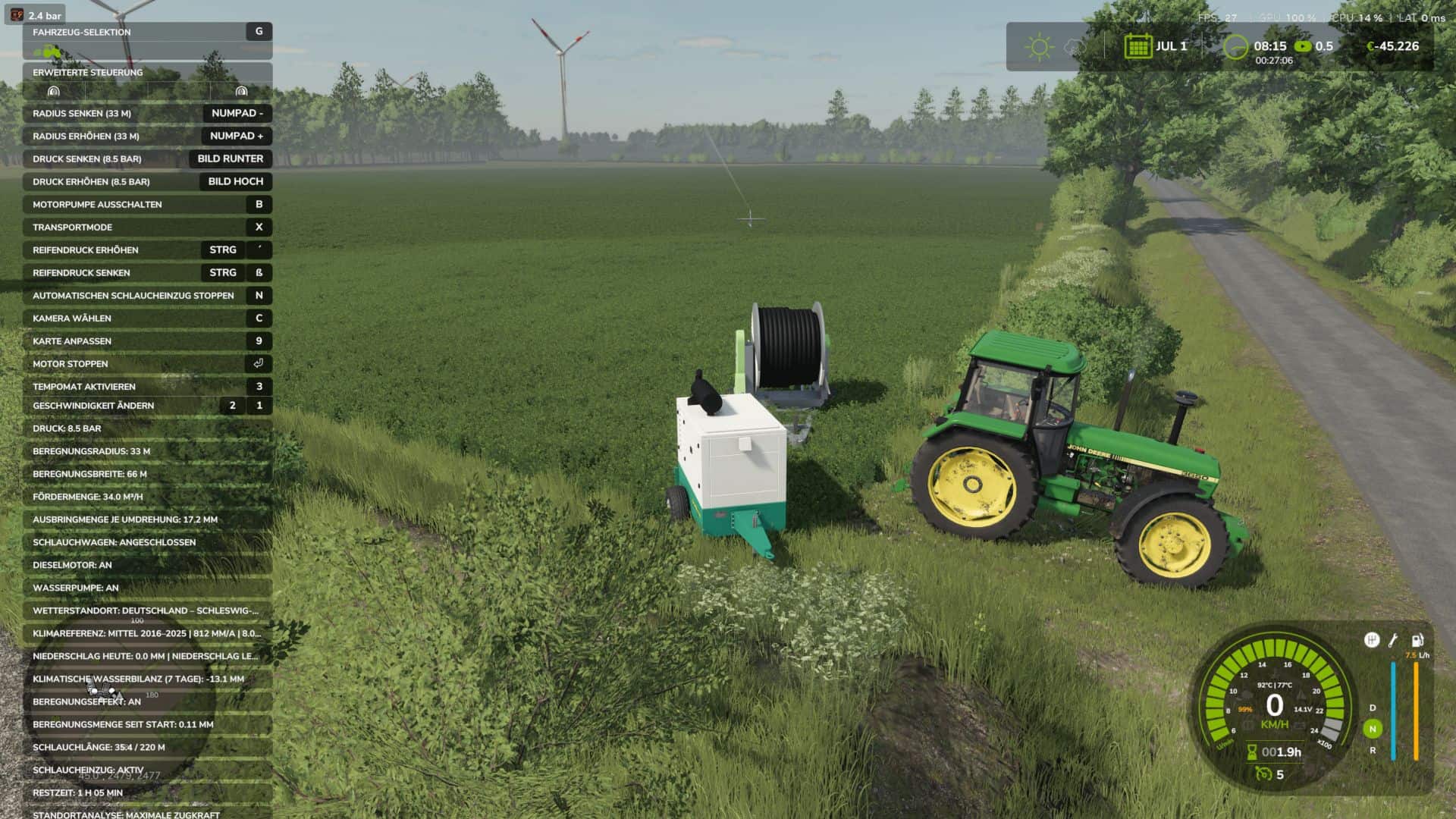
Bauer Rainstar T32
– The included Rainstar features:
– up to 220 meter hose length
– movable sprinkler cart
– automatic hose retraction
– automatic parking brake
– pivoting irrigation sector
– Realistic water jet and spray
– visible impact effects on the ground
– adjustable pump pressure
– adjustable irrigation radius
– calculated application rate
The pump pressure can be adjusted from 3.5 to 11.0 bar. The radius is between 27 and 38 meters. Pressure and radius influence flow, jet width, strip width, water distribution, application height and motor speed.
The pull-in speed is approximately 42 meters per hour. The hose reel remains largely stationary during retraction while the sprinkler carriage moves to the reel.
Diesel pump and groundwater
The motor pump has a 450 liter diesel tank and consumes approximately 5 liters of diesel per hour under high load. The diesel must be refueled regularly.
The water comes from groundwater and is available in unlimited quantities. The internal water level is automatically filled and does not appear as a limited tank.
The diesel engine and the water pump are separate operating states. The engine sound starts at idle, increases depending on the pressure when the water pump is switched on and falls back to idle after switching off. The pump only works when the engine is running, the work mode is activated and the Rainstar is connected correctly.
A coupling aid shows the actual connection with a green 3D marker, a distance indicator and an on-screen hint.
Direct soil input through irrigation
The water applied is not just an optical effect. It is distributed on topsoil, root zone and subsoil. Pressure, radius, flow, irrigation time, soil type, saturation and infiltration ability are taken into account.
Too much water can cause surface runoff, poor traffic, waterlogging, root damage and mud.
Plant dependent calculation
RWSM recognizes numerous crops including wheat, barley, oats, corn, canola, sunflower, soybeans, potatoes, sugar beets, grass, alfalfa, sorghum, cotton, sugar cane, rice, peas, beans, spinach, carrots, parsnips and beets.
For each crop, the optimal moisture range, sensitivity to drought and waterlogging, root depth, nitrogen requirement, pH range, sensitivity to compaction and temperature limits are used, among other things.
Root Health
– The mod simulates main roots, fine roots and usable root depth. Root damage occurs due to:
– long-lasting waterlogging
– Lack of oxygen
– extreme dryness
– Top and subsoil compaction
– deep lanes
– repeated crossings
– high wheel load and slip
– Driving on wet groundFine roots react faster and stronger. Recovery only occurs slowly and with suitable moisture, low compaction, good drainage and appropriate temperatures. No living roots are simulated on uncultivated areas.
Soil compaction and vehicle traffic
Vehicle traffic is detected at the wheel contact points. Vehicle weight, wheel load, tire width, ground pressure, tire pressure, slip, speed, soil moisture and repeated passes have an influence.
The following are calculated:
– Topsoil compaction
– Subsoil compaction
– Track depth
– Carrying capacity
– Sink factor
– Trafficability
– possible root damage
On dry ground the effects remain minimal. On wet or already compacted soil, compaction, sinking and damage increase significantly.
Tillage
RWSM detects plowing, cultivating, disc harrowing, subsoiling, sowing, rolling, fertilizing and vehicle traffic.
Plowing and cultivating can reduce compaction but can cause structural damage if the soil is too wet. Deep loosening only works reliably in a suitable moisture window. Rolling can provide useful reconsolidation after sowing, but can significantly increase compaction on wet soil.
Drivability, tire moisture and mud
The soil is graded from dry to extremely muddy. The assessment uses local values for moisture, saturation, soil type, bearing capacity, compaction and track depth.
Damp ground initially creates a film of moisture or soil on the tire. Heavy mud only occurs when there is high saturation, decreasing load-bearing capacity and measurable sinking.
Through the public Water-Soil API, RWSM can work with compatible mods such as Visual Mud Tracks. RWSM provides ground condition while the other mod can handle tire optics and particles. This avoids double traffic calculations.
Weed competition
Living weeds take away water and compete for nutrients. The effect depends on weed strength, area covered, crop type, growth phase and soil moisture.
Young crops such as corn, potatoes, beets and vegetables are particularly sensitive. After successful treatment with a harrow, hoe or herbicide, the additional water consumption ends automatically.
The normal weed yield deduction from the base game or precision farming is also retained.
Realistic yield calculation
– The actual yield is influenced on the server side. To be taken into account:
– Soil moisture and saturation
– Drought and waterlogging stress
– Root and fine root health
– Compaction and track depth
– Weed competition
– Nitrogen and pH
– Temperature and evaporation requirements
– Plant type and growth phase
– long-term soil history
The RWSM yield factor is approximately between 28 and 103 percent. Only the amount of harvest is changed; the physically harvested area remains unchanged.
Precision farming compatibility
Precision farming is automatically detected. Nitrogen, pH, soil information and yield potential can be adopted. To ensure that nitrogen and pH are not penalized twice, RWSM reduces their additional weighting when precision farming is active.
Simplified:
Basic game or PF yield × RWSM soil factor = actual yield
Visible plant development
RWSM can use existing LS25 growth stages to reveal local differences. Water stress, root damage, compaction and yield potential can cause plants to appear smaller or less developed in individual areas. Stocks that are ready for harvest remain fully harvestable.
The following are saved and synchronized, among other things:
– Soil water of all layers
– Rainfall and irrigation history
– Compaction and track depth
– Root health and stress levels
– Weed pressure
– Earning potential
– Edit history
– Traffic crossings
– Pump pressure, radius and hose position
– selected weather region
The calculation is server authoritative and designed for multiplayer.
Water-Soil API
RWSM provides a versioned interface. Other mods can query soil type, moisture, saturation, trafficability, load capacity, sink factor, compaction, track depth, root health, tire moisture, mud intensity and recommended tire pressure, among other things.
Current state of the user interface
In version 1.33.1, the additional RWSM map category, the map overlay, the additional field info window and the FieldPhone are disabled for the time being. The complete weather, soil, root, weed, irrigation and yield calculations continue to run in the background.
Required:
– Precision Farming
– Visual Mud Tracks